An ERROR in your logs doesn’t automatically mean an ERROR in your traces.
The sampling gap#
In Python, it’s common to catch an exception, log the failure and return a response. The operation failed, but unless something also updates the OpenTelemetry span status, the span can finish without an error recorded.
This matters when you use tail sampling: waiting for traces to finish, then deciding which ones to store. A common policy keeps traces exceeding a given duration or containing an ERROR span, and a small percentage of everything else. If the failure only reached your logs, the trace you need to debug it might get dropped.
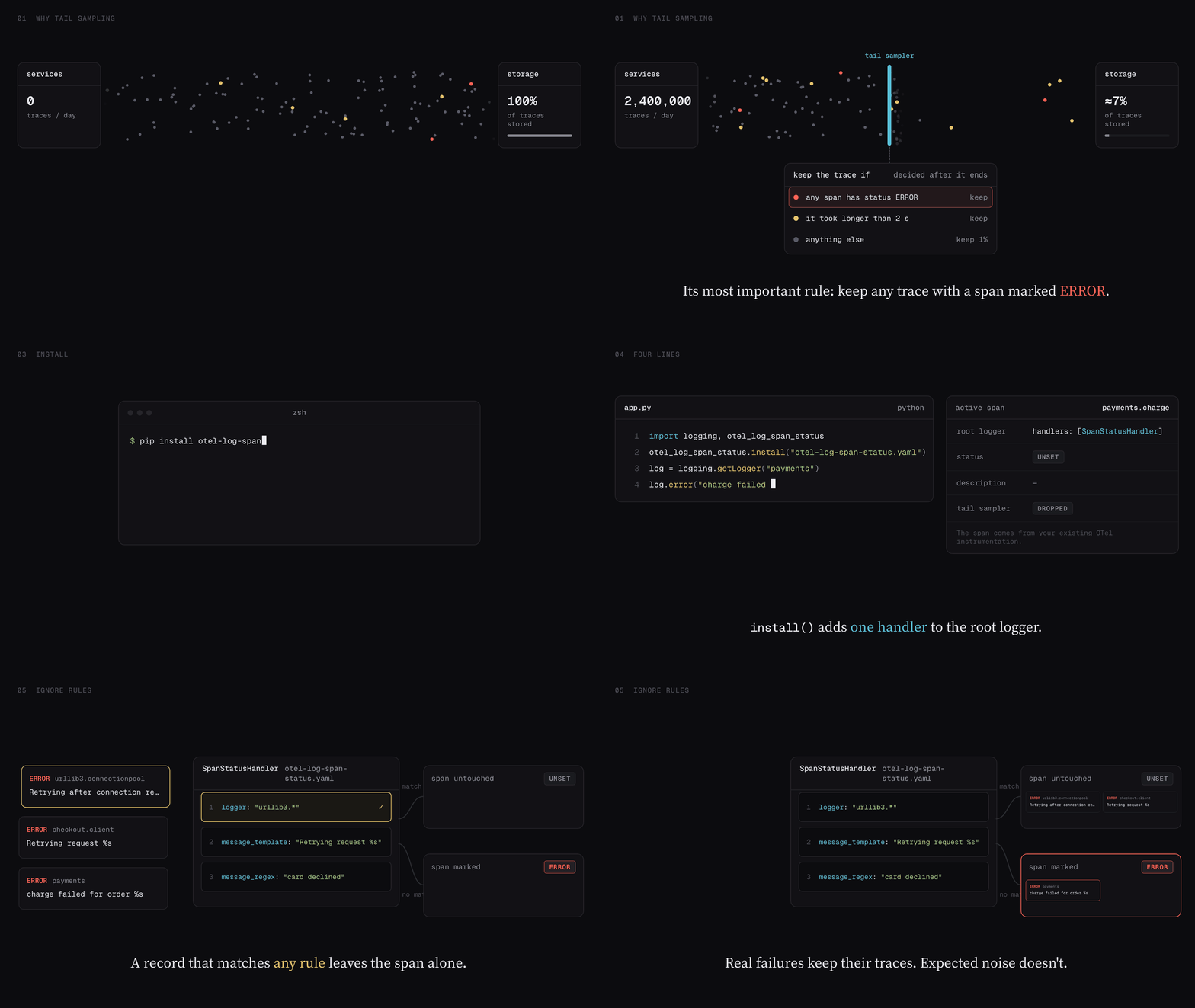
Manually setting span status in every error-handling block is tedious. Automatically setting span status through a generic log handler for every log at ERROR level or higher (CRITICAL/FATAL) has its own shortcoming. A retry that eventually succeeds or a noisy library can cause traces to be kept unnecessarily. You end up paying to store the noise.
What the library does#
I built otel-log-span-status to connect the two:
import otel_log_span_status

otel_log_span_status.install("otel-log-span-status.yaml")
It adds a handler to Python’s logging system. An ERROR-level or higher log marks the active recording span as ERROR. A YAML ignore list lets each service exclude known noise:
ignore:
  - logger: "myapp.legacy_cache"
    message_template: "Cache miss for user %s, falling back to DB"
Here, both the logger name and the unformatted message template must match. The log is still emitted; the handler leaves the span alone.
The library doesn’t configure your sampler or fix noisy logging. It gives your existing sampling policy a signal that would otherwise exist only in your logs, with service-specific rules for what deserves that signal.
I’ve written more about dealing with noisy error logs in Noise Tax on ERROR Logs.